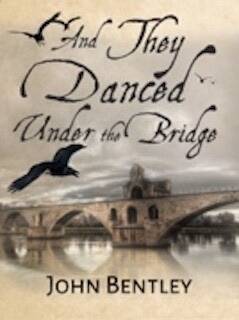
I am a Francophile and I speak French. I am interested in French history, especially that of the Late Middle Ages. The defensive walled town of Avignon has always fascinated me. These elements provided a cornucopia of conflict and friendship for my first novel, "And they danced under the bridge". The St.Benezet bridge once linked Avignon to Villeneuve and the regions beyond. Originally a wooden structure, later stone, I found it was only 16 feet across on top - too narrow for dancing. The nursery rhyme, Sur le pont d'Avignon, begins with sur - on - yet other versions start with sous - under. It is more logical, and practicable, that it was under the famous arches that some dancing and also buying, selling and other questionable activities took place.
The boy who would become Pope was one Pierre Roger. I create a childhood friend, Marius, who beats him severely one day in an argument. His victim will harbour a burning desire for vengeance and their paths next cross when he is the Pontiff and Marius a stonemason's labourer in Avignon. The plague arrives in 1348 and quickly tightens its grip on the town: black swellings; fevered delirium; breath that rattles like broken glass. One figure emerges who will lead the people against the scourge, seeing to families who are quarantined, wrapping corpses in shrouds, collecting bodies and their burial in graves but later casting them into the river Rhone. It is dangerous work that Marius undertakes bravely, with endurance and compassion.
Meanwhile, we know that Pope Clement Vl is isolated in the Palais des Papes within the walled town. He protected himself in front of log fires but he ordered his physicians to tend the sick people. He consecrated the river for bodies to be cast and he defended the Jews who were wrongly blamed for the plague. So, a good man, but I see him turning to addictive laudanum for support. Also, I endow him with a mistress, Alice.
My Marius will fall in love with Alice and take her from Clement when his own wife dies, ironically, from the pestilence. I see them marrying and the pope expires, peacefully, his vengeance defeated on appreciating Marius's courageous actions. It is the tension between events in the deadly streets and the intimacy of kindness and love that drew me to writing this novel.
Research alone was not enough - the real challenge was weaving together truth and imagination. My aim was not simply to recreate the past but to make it feel alive through my protagonist, Marius, and my antagonist, Clement. Something beyond belief becoming close and tangible reminds us that medieval people were not abstractions: they were flesh and blood, with fears, hopes and dreams as vivid as our own.
My next two novels - "Fist of the faith" and "The Guise of the Queen" - tell stories of heroes and villains framed by historical fact.
You are invited to post your comments.
Add comment
Comments
Nicely written and a valuable insight into your work, mr Bentley.